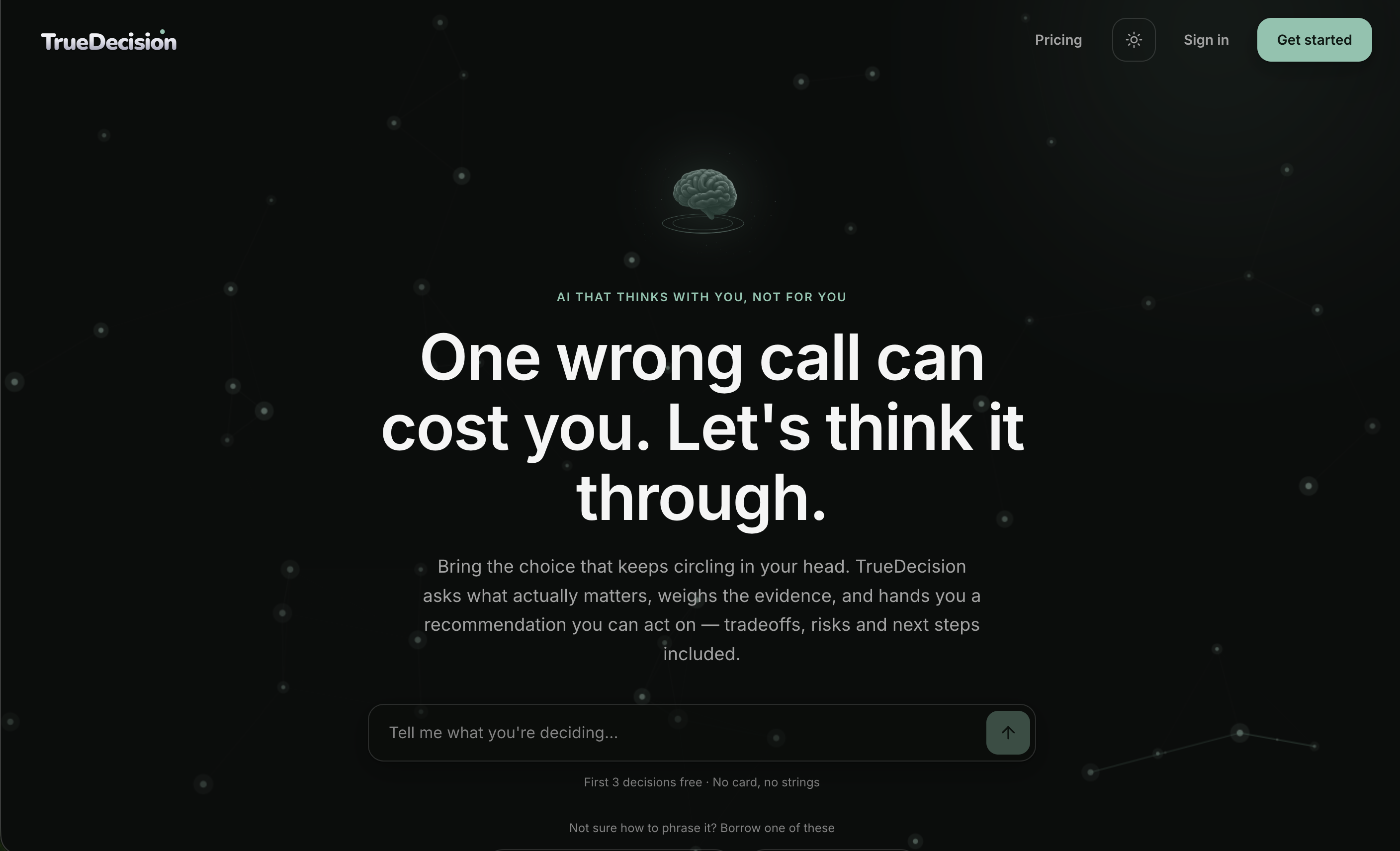
The problem: we decide badly in our heads
Faced with a decision involving several options and several factors, the human mind compares poorly. We anchor on the first option we saw, overweight whatever is most recent, and confuse "what I feel like" with "what's actually best for me". The result is a decision that's hard to justify afterwards, even to yourself.
The techniques to avoid this have existed for decades — separate options from criteria, assign weights, score each combination — but almost nobody applies them, because doing it by hand in a spreadsheet is tedious. TrueDecision exists to remove that friction.
What I built
Structuring the decision
Defining the options under consideration and the criteria they'll be compared against, keeping the two separate.
Weighted criteria
Not every factor matters equally. Assigning importance to each criterion is what separates a useful analysis from a pros-and-cons list.
An explainable result
A recommendation you can defend, because it shows where it comes from and which criterion tipped it.
Frictionless interface
A single-page application: the analysis updates instantly as weights and scores change.
Technical decisions
It's built as a SPA deployed on Vercel. For a tool whose whole value is immediacy — you move a weight, you watch the result shift — client-side rendering is the natural choice: every adjustment has to show up instantly, with no server round trip.
The real challenge in a product like this isn't technical, it's product design: a decision tool that demands too much effort up front doesn't get used. If you ask someone to define ten criteria and weight them before showing them anything, they leave. The balance between methodological rigour and minimum effort is the axis the entire interface design turns on.
Have a product idea?
Taking an idea for a tool and turning it into a usable web application takes as much product judgement as code. If you have a concept in your head and need someone to build the whole thing — interface through to deployment — let's talk.