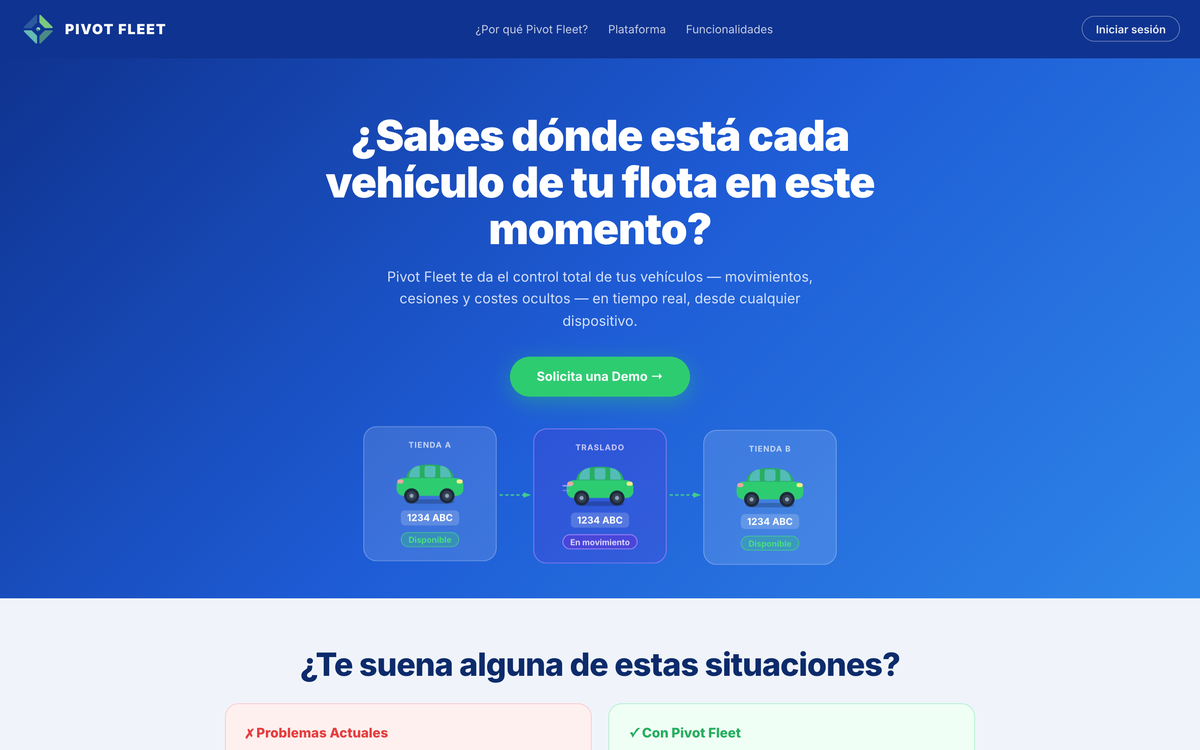
The problem: a fleet run on spreadsheets
A dealership moving courtesy cars, demo vehicles and loan units always faces the same mess: a spreadsheet of licence plates, a folder of paper contracts, traffic fines that arrive months later with no record of who was driving, and a workshop working from handwritten notes. Once the fleet grows, that system stops scaling and starts costing real money in misassigned fines and idle vehicles.
Pivot Fleet was built to replace all of it with a single source of truth, reachable from the browser and from the phone of the salesperson handing over the car.
What I built
Real-time traceability
Status and location of every vehicle in the fleet, with a full movement history and an assigned owner at all times.
Digital agreements with mobile signature
Loan contracts generated and signed straight from a phone or tablet — nothing printed, nothing scanned.
Fines management
Fines recorded and cross-referenced against the assignment history to automatically identify who was responsible on the date of the offence.
Workshop panel
Tracking of intakes, repairs and availability, so you know which vehicles are actually operational before committing them.
Technical decisions
The backend is built on Yii2 and the frontend is a Vue SPA. For a tool used intensively every day — where a user spends hours filtering lists, opening records and changing statuses — navigation without reloads is what separates a tool people use from one they abandon.
The trickiest piece was the data model for the assignment history. For automatic fine attribution to work, every assignment has to be an immutable record with an exact time range: who had the vehicle, from when, until when. Without that design, reliably matching a fine to its driver is impossible.
Mobile signing also forced a mobile-first flow: the salesperson handing over a car is not sitting at a desk, they are in the car park with the customer standing next to them.
Do you need something like this?
If you manage a fleet — dealership, corporate or rental — and still depend on spreadsheets and paper, the problem is not a lack of generic software: it is that none of it fits how you actually operate. I build these platforms from the data model to deployment.